Architecture
Resource
Intro
Components
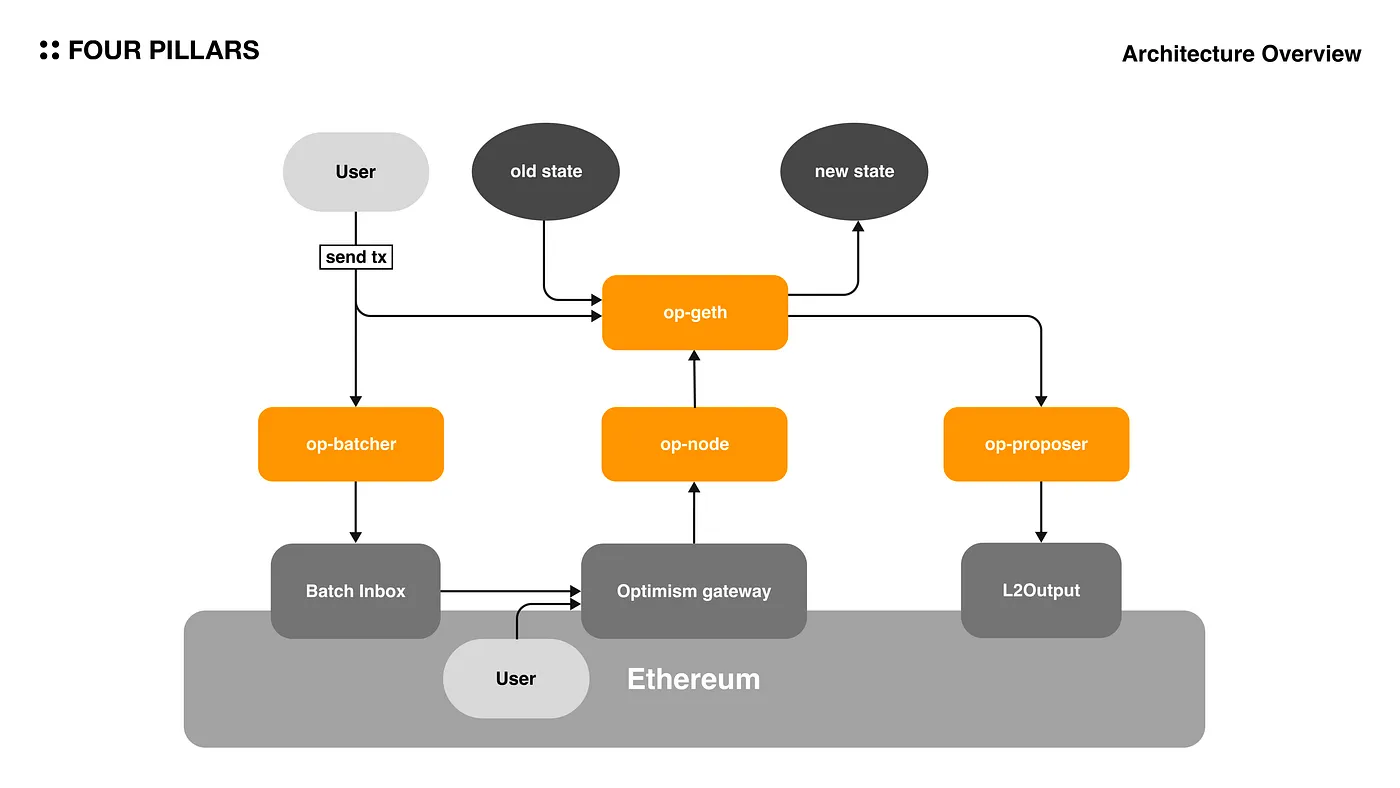
The OP-Stack solution encompasses four essential components: nodes (op-geth, op-node) and sequencer-specific components (op-batcher, op-proposer). Each plays a distinctive role in enabling the rollup process.
Nodes:
op-gethsits at a key transaction process intersection, channeling user transactions to the Execution Layer, ensuring accurate and efficient network transactions. Additionally,op-gethadjusts the state based on the transaction, applying transactions to the preceding state to create the new one. It manages the state's storage and modification throughout the transaction process, thus accurately reflecting all state changes.- The
op-nodecomponent is integral to converting raw data from the Data Availability Layer into processed inputs for the Execution Layer via the standard Ethereum Engine API. It sources inputs from Ethereum block data, Sequencer transaction batches, and Deposited transaction events, with the current system state guiding its parsing of raw input data. This mechanism ensures efficient and precise data processing. Functions include L2 deposit and withdrawal transactions submission to L1, failed transactions retry, L2 transaction statuses update, and L1 gas prices calculation based on recent tips.
Sequencer-specific:
op-batchermainly handles writing transactions to the L1 network (Ethereum), compressing transactions to optimize network efficiency and streamline data transmission and storage.- Lastly, the
op-proposeris crucial in finalizing state transitions. After op-geth has modified the state, op-proposer writes a commitment to the post-transaction state to L1, thereby recording the updated state. It proposes the new Merkle root of the updated state, utilizing Merkle roots to minimize the data written to L1, thereby reducing transaction costs. These state root proposals are posted to the L2OutputOracle on the L1 network. These output proposals must undergo a 7-day fault challenge period before gaining authority, facilitating potential disputes and challenges, which enhances network reliability and accountability.
Process
Interoperability